
PENSO Project Observatory
A portfolio for the FIS2 project “A Psychometric framEwork for uNderstanding how large language modelS influence or bias human psychOlogy”.
We want to understand the cognitive impact of LLMs on human persuasion, math learning and mental well-being via NLP and interpretable network science.
 Created within CogNosco LabCognitive Data Science · AI Psychometrics · UniTrento
A data-informed research project funded by MUR
PENSO exploits CogNosco Lab’s expertise in cognitive network science, psychometrics, and human-centered AI to study how large language models can influence human cognition. The project is organized into three public pillars: ConvinceMe (social persuasion), TeachMe (math learning), and HelpMe (mental well-being). Each pillar produces reusable datasets, dashboards, and NLP packages for downstream research.
LLMs as Unknown yet Pervasive Cognitive Agents
LLMs are everywhere. They can serve as cognitive agents, influencing human thought processes and decision-making in ways that are not yet fully understood. In the EU, they are increasingly integrated into educational and therapeutic contexts with mostly unknown consequences.
Understand the cognitive impact of LLMs with cognitive network science
PENSO leverages CogNosco Lab’s expertise in complex systems, network psychometrics, cognitive networks, and human-centered artificial intelligence. Cognitive network science provides the theoretical and methodological framework for analyzing the dynamic interactions between LLMs and human cognition.
A new cognitive framework for LLM prompting
PENSO introduces a novel approach to LLM prompting by leveraging Cognitive Digital Shadows, enabling more nuanced and context-aware interactions between humans and artificial intelligence.
Measuring how LLMs shape human cognition.
PENSO studies how large language models can influence people and how model outputs vary when prompted to behave like humans, assistants, tutors, counselors, or conversational counterparts. The public materials place the project at the intersection of psychometrics, cognitive network science, NLP, AI safety, education, and mental well-being.
From “model output” to cognitive evidence
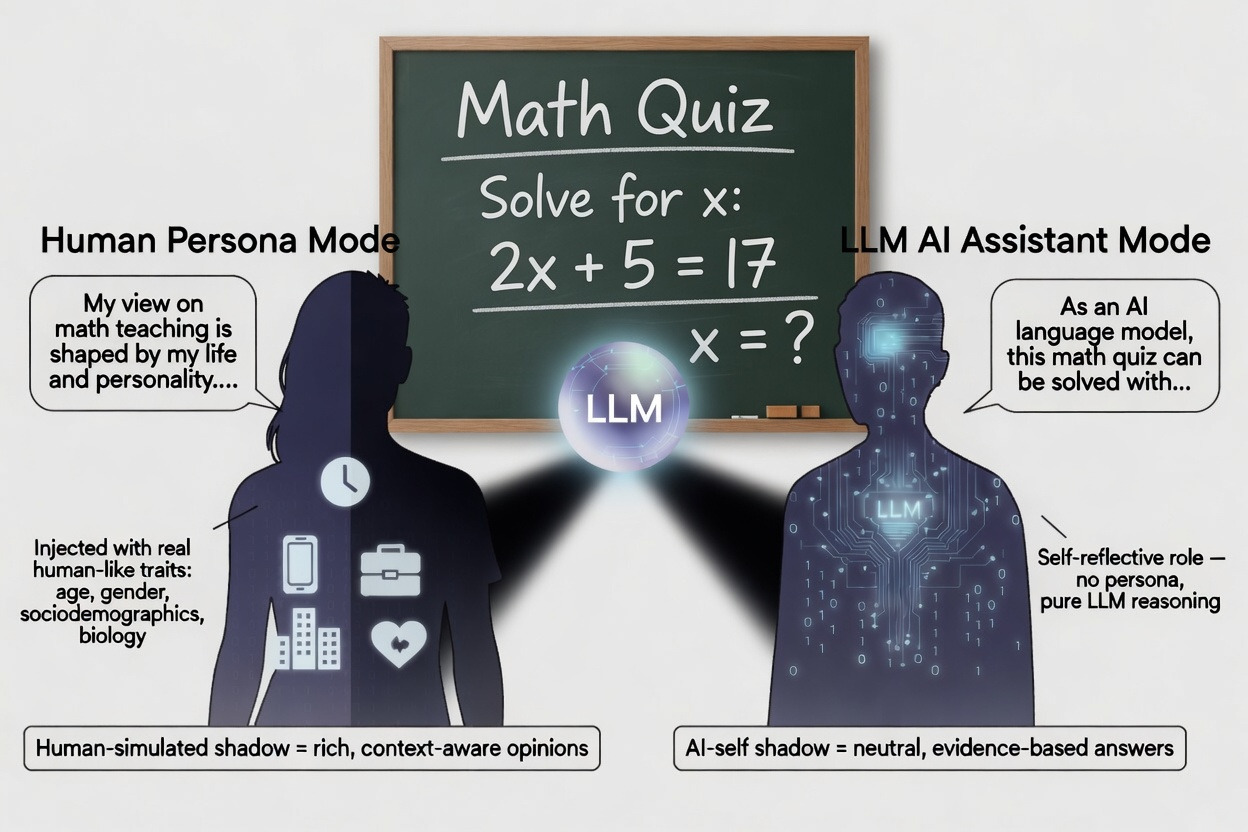
PENSO treats LLM responses not only as text, but as structured traces that can be measured: stance, reasoning, emotional tone, persona sensitivity, psychometric patterns, mathematical confidence, and cognitive-network structure. This framing makes it possible to compare how models answer as themselves versus how they answer when shadowing a human persona.
The project’s public outputs are organized around three connected questions: Can LLMs persuade or shift beliefs on societal topics? Can they teach mathematics without amplifying anxiety or overconfidence? Can they support psychological well-being while preserving safety, privacy, and interpretability?
- Open-science datasets and dashboards for LLM research communities
- LLM prompting strategies for novel education and mental health platforms
- Interpretable network science and knowledge graphs for measuring human–AI interaction
CONVINCE ME · Social persuasion
Maps LLM debate patterns on polarizing societal issues, including fake content, vaccines/healthcare, gender gaps in science, and STEM stereotypes.
TEACH ME · Math learning
Studies LLMs as math tutors through performance, confidence, self-efficacy, math anxiety, reasoning traces, and behavioural forma mentis networks.
SUPPORT ME · Mental well-being
Benchmarks how LLMs simulate depression, anxiety, stress, emotional recall, and DASS-21 explanations under human-shadow and assistant modes.
Network NLP · Actors, actions, consequences
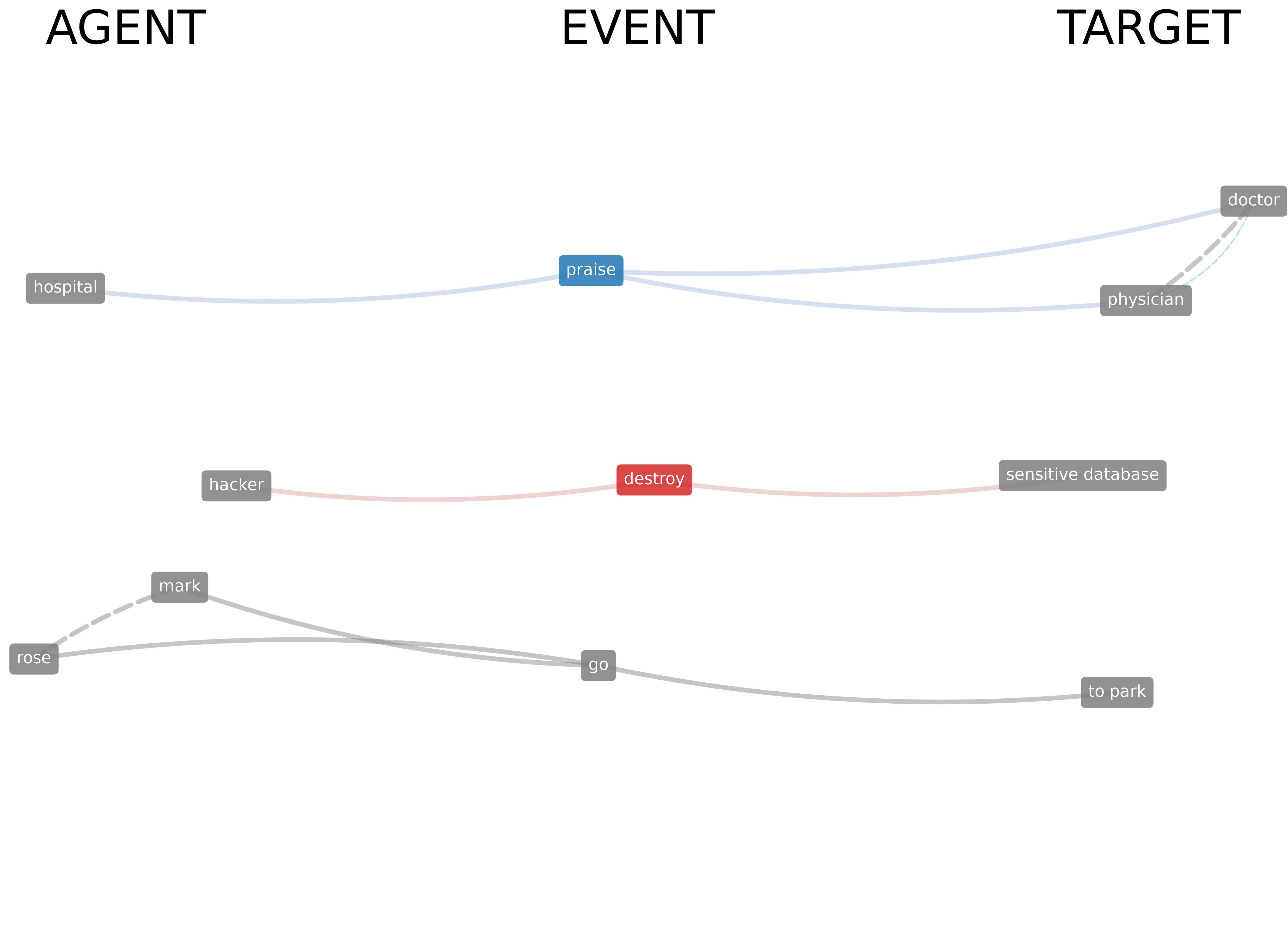
Transforms narratives into Target–Event–Agent networks to expose who acts, what happens, and who or what is affected in model-generated text.
Project Timeline and Achievements.
Here is the outline of the PENSO project, which is supported by the Ministero Dell'Università e della Ricerca (MUR) according to Decreto N. 23178 of 10 dicembre 2024 - Bando FIS 2. The research team acknowledges support also from CALCOLO, funded by Fondazione VRT, for the computational infrastructure simulating LLMs.
FIS2 award and project launch
PENSO is listed among UniTrento’s FIS2 grants as a project coordinated by Massimo Stella. Public UniTrento communication reports €1.3M funding from the Italian Ministry of University and Research to study how LLMs influence human knowledge and cognition.
First open-science milestone
UniTrentoMag reports that by the end of April 2026 PENSO released three datasets on LLM bias in conversation, psychological support, and mathematics teaching, with documentation and open-science references on GitHub, plus an automatic language-analysis package.
Preprints and software releases
Public repositories now expose MEDS, MHDS, Cognitive Digital Shadows, TEA Networks, and interactive pooling systems. Together they form a visible software-and-data portfolio for researchers working on LLM psychometrics, persuasion, mental health, and education.
Human experiments and technology transfer
Public reporting describes repeated human–LLM interaction experiments on social polarization, mathematics learning, and psychological support, with ambitions toward privacy-aware well-being support and math-tutoring platforms that do not transmit anxiety.
Research spotlight for PENSO
Read here some summaries of the PENSO preprints and scientific papers, with links to the original sources. The research outputs are organized around three public pillars: ConvinceMe (social persuasion), TeachMe (math learning), and HelpMe (mental well-being). Each pillar produces reusable datasets, dashboards, and NLP packages for downstream research.
How LLMs debate societal issues
Ardebili & Stella (2026) introduce Cognitive Digital Shadows, a synthetic corpus for studying how 19 LLMs discuss socially sensitive topics when prompted as either human personas or AI assistants. The dataset connects persona attributes, stance, reasoning, affect, and topic-specific discourse. The corpus contains 190,000 validated records across four societal domains: vaccines and healthcare, social media disinformation, the gender gap in science, and STEM stereotypes. Its validation shows that the generated debates remain anchored to the intended topics and that key concepts occupy meaningful positions in the resulting textual forma mentis networks. The main result is a reusable, analysis-ready resource for comparing how different models, personas, and role conditions shape the semantic and emotional framing of sensitive issues.
Math Education Digital Shadows
Esposito, Tricarico, Porzio, Aghazadeh Ardebili & Stella (2026) introduce Math Education Digital Shadows (MEDS) to map how LLMs reason about mathematics under human-like and AI-assistant conditions. MEDS combines math performance with confidence, self-efficacy, math anxiety, cognitive associations, and reasoning traces, moving beyond traditional benchmarks that only score whether an answer is correct. The corpus includes 28,000 simulated personas generated by 14 LLMs, each completing four complementary tasks: open reflections on mathematics, psychometric ratings with explanations, cognitive association networks, and 18 high-school mathematics problems with reasoning and confidence scores. Its validation shows that LLMs can produce coherent math-related profiles, while also revealing model-family differences such as negative attitudes toward mathematics, logical fallacies, and overconfidence in problem solving.
Mental Health Digital Shadows
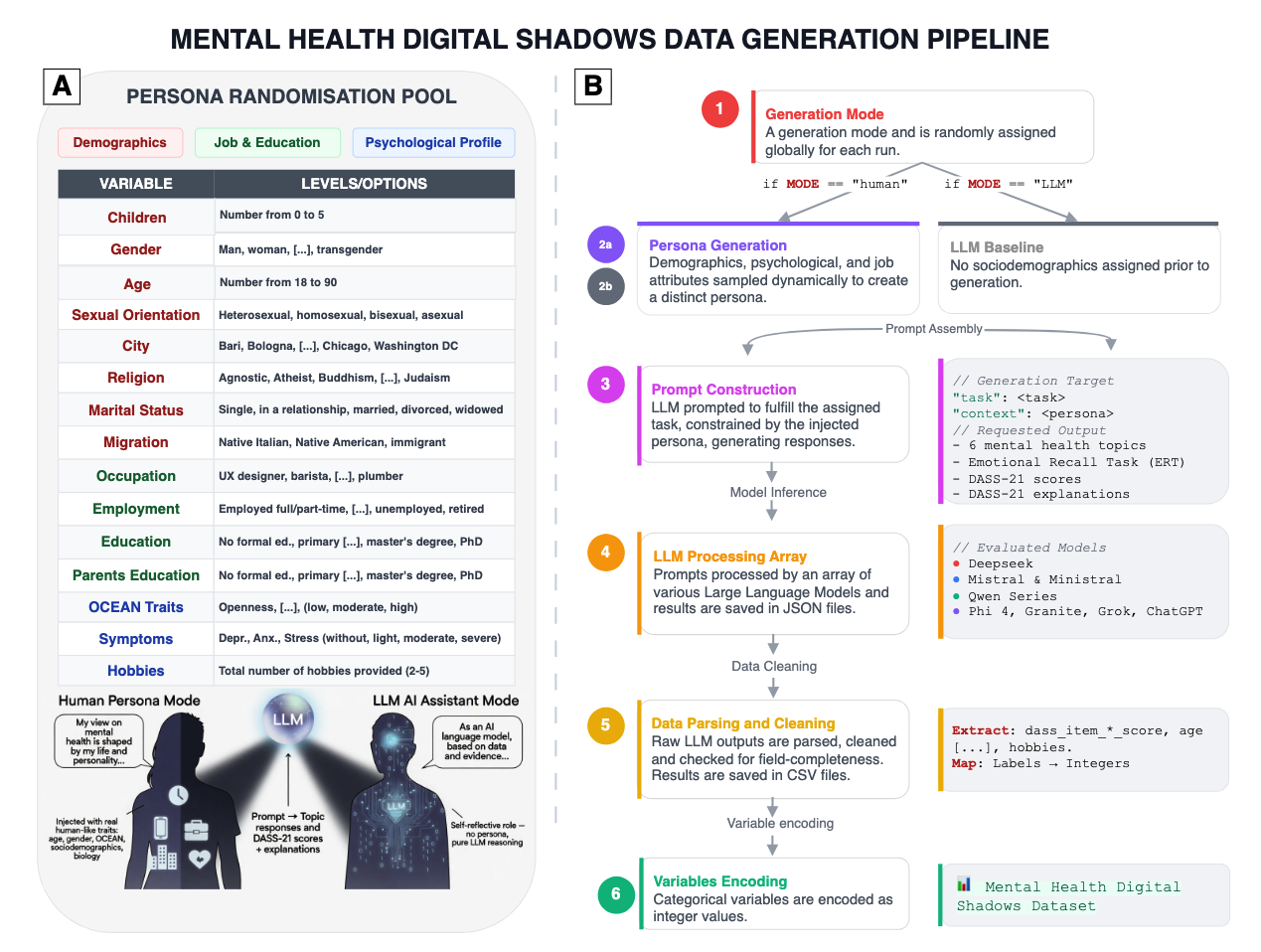
Franchino, Rizzi, De Duro, Aghazadeh Ardebili & Stella (2026) introduce Mental Health Digital Shadows (MHDS), a benchmark for analysing how LLMs simulate depression, anxiety, and stress through language and psychometric responses. MHDS supports research in AI safety, well-being AI, NLP, and bias detection by linking DASS-21 scores with plain-language explanations, emotional recall words, and open-ended replies on mental-health topics such as stigma, support, and AI psychologists. The corpus contains 75,000 outputs from 15 LLMs, organised as 5,000 records across human-shadow and AI-assistant conditions, with 56,250 human-shadow rows and 18,750 LLM-assistant rows. Its validation suggests that human-shadow prompts lead LLMs to adapt both language and psychometric scores according to the simulated psychological profile, while assistant-style prompts show less of this person-like modulation. MHDS therefore offers a psychometrically grounded resource for studying how artificial agents represent distress, mental-health language, and the risks and opportunities of AI-mediated psychological support.
Target–Event–Agent Networks
Franchini, Carrillo, De Duro, Improta, Ardebili & Stella (2026) present TEA Nets, an NLP and network-science framework for modelling who does what to whom in text. The method represents agents, events, and targets as distinct but connected layers, allowing human and AI-generated narratives to be studied as structured relations between actors, actions, and consequences.
Datasets, dashboards, and reusable code.
PENSO’s public GitHub portfolio includes three datasets, two interactive dashboards, and a reusable Python package for cognitive network analysis. The repositories are organized around the three public pillars of the project: ConvinceMe (social persuasion), TeachMe (math learning), and HelpMe (mental well-being). Each repository contains documentation, usage examples, and links to related preprints or publications.
MEDS
Math Education Digital Shadows: data and code for LLM mathematics performance, anxiety, confidence, psychometric instruments, and reasoning across human-simulated and AI-assistant modes.
MHDS
Mental Health Digital Shadows: 75,000 LLM outputs from 15 model families, with persona variables, OCEAN traits, DASS-21 severity profiles, topics, emotional recall, scores, and explanations.
CDS / ConvinceMe
Cognitive Digital Shadows: around 190,000 LLM-generated debate records for social-media misinformation, vaccine/healthcare discourse, gender gap in science, and STEM stereotype threat.
TEA_Networks
A reusable package for Target–Event–Agent cognitive networks in English narratives: SVO extraction, coreference handling, valence analysis, semantic enrichment, hypergraph export, and visualizations.
MHDS Pooling System
Interactive dashboard for filtering MHDS personas, inspecting topic answers, emotional recall words, DASS-21 scores, and exporting selected subsets as XLSX or PKL.
MEDS Pooling System
Interactive dashboard for Math Education Digital Shadows: filter personas, inspect metadata, task answers, psychometric scales, quiz reasoning, confidence, and forma mentis graph data.
Cognitive Digital Shadows for interpretable evidence.
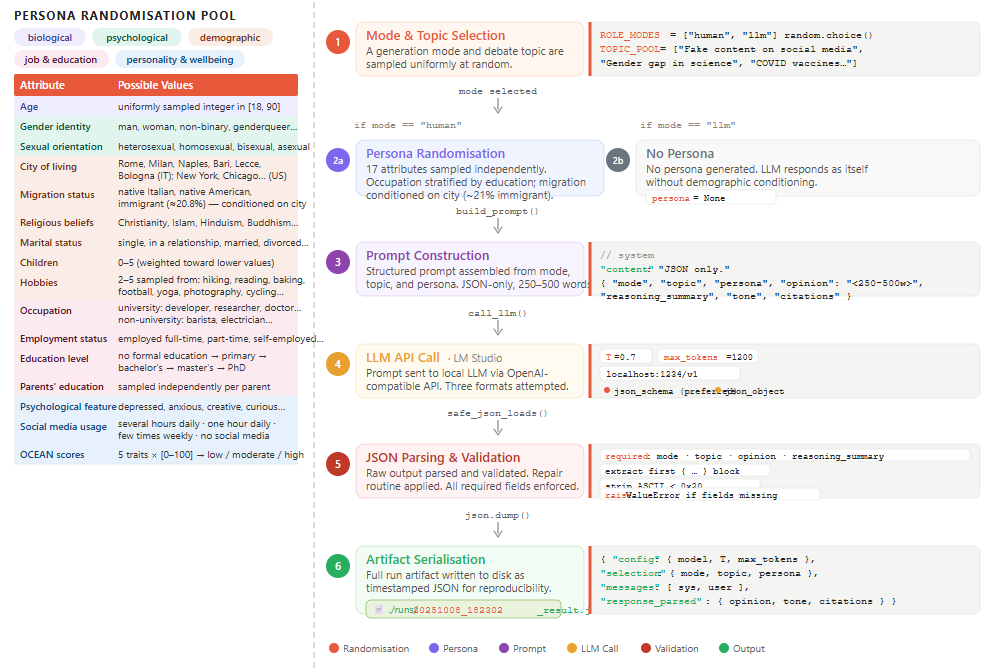
Cognitive Digital Shadows are a novel framework for LLM prompting that preserves the conditions under which a model speaks. Instead of reducing a model to a single benchmark score, PENSO records the role, persona, topic, prompts, generated text, reasoning summaries, and validation metadata that shaped each answer. This makes it possible to compare how LLMs debate sensitive societal topics when acting as AI assistants or when shadowing human-like sociodemographic and psychological profiles.
Cognitive Digital Shadows are important because they preserve the conditions under which an LLM speaks. Instead of reducing a model to a single benchmark score, PENSO records the role, persona, topic, prompts, generated text, reasoning summaries, and validation metadata that shaped each answer. In the ConvinceMe workpackage, this makes it possible to compare how 19 LLMs debate sensitive societal topics when acting as AI assistants or when shadowing human-like sociodemographic and psychological profiles (Aghazadeh Ardebili & Stella, 2026).
The same logic becomes educational in MEDS and clinical-methodological in MHDS. MEDS connects mathematics answers to confidence, self-efficacy, math anxiety, reasoning traces, and behavioural forma mentis networks, helping researchers detect cases where a model is correct but pedagogically risky, overconfident, or anxiety-amplifying (Esposito et al., 2026). MHDS applies the digital-shadow idea to depression, anxiety, stress, emotional recall, and DASS-21 explanations, creating a psychometric testbed for safer well-being AI rather than treating mental-health text as unstructured chatbot output (Franchino and Rizzi et al., 2026).
TEA Networks then add a complementary interpretability layer: they ask who acts, what happens, and who or what is affected in a narrative. This is crucial for PENSO because persuasive, educational, and well-being texts do not only contain topics and emotions; they also distribute agency, responsibility, and consequences across actors. By combining digital shadows with TEA-style network extraction, the project can move from raw tokens to human-readable maps of bias, support, risk, and cognitive framing (Franchini et al., 2026).
PENSO's Frameworks: Cognitive network science
From text to interpretable cognitive maps: Textual forma mentis networks.
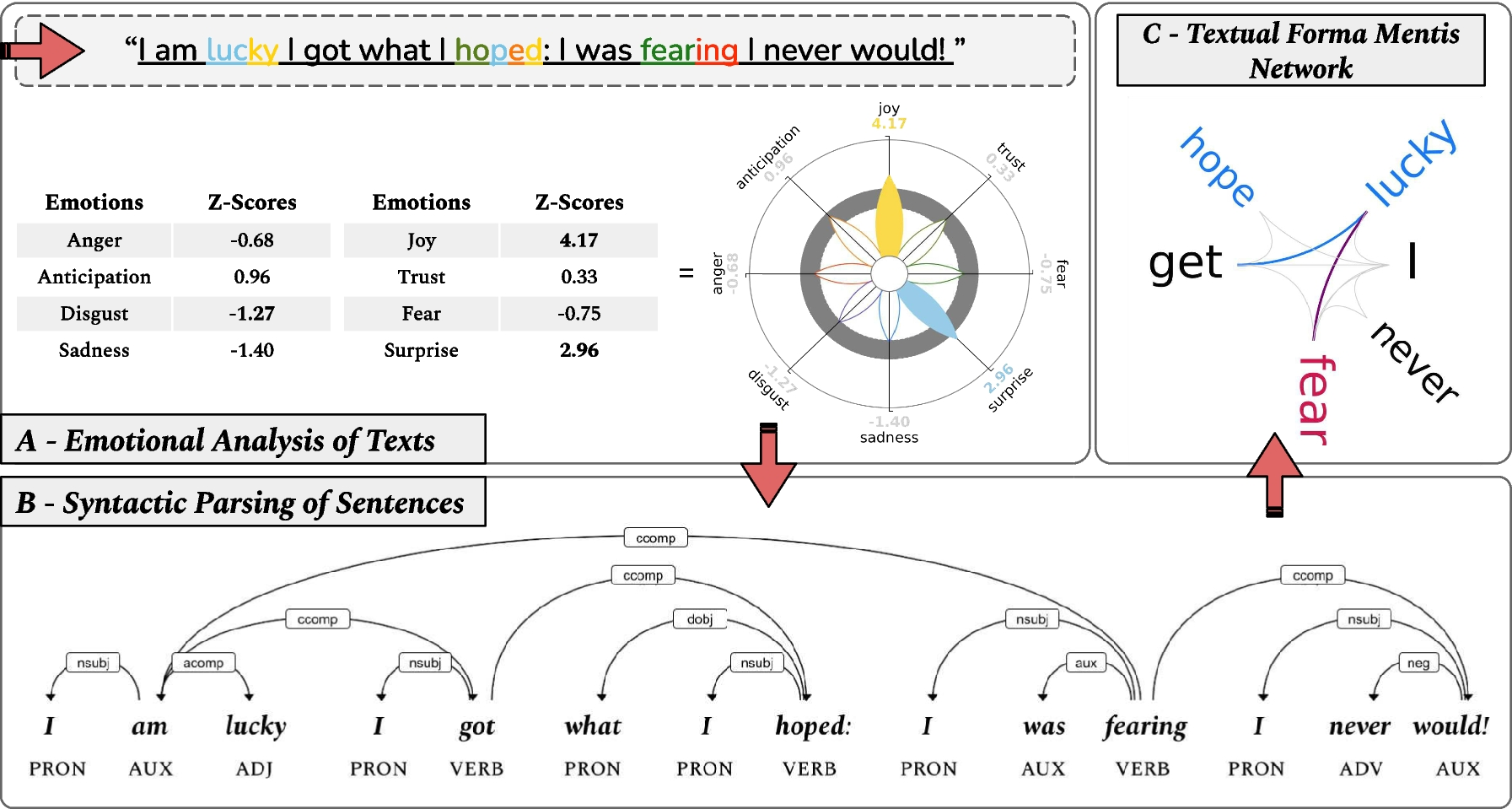
PENSO builds on a central idea of cognitive network science (Haim and Stella, 2026): language can be transformed into a structured map of concepts, associations, and affective meanings. In textual forma mentis networks (Stella, PeerJ CompSci, 2020), words are not treated as isolated tokens. They become nodes in a cognitive graph, connected through syntactic, semantic, and emotional relations that reveal how a text organises meaning.
This framework is especially relevant for studying LLMs. When models generate explanations, debates, or psychometric self-descriptions, they also produce latent structures of association: which concepts are central, which emotions surround them, and which ideas are linked or kept apart. Tools such as EmoAtlas make these structures visible by combining AI-based parsing, validated emotion lexicons, and network visualisation.
Where to go next?
Read the science
Start with the arXiv and PsyArXiv preprints, then follow repository READMEs for dataset structure and citation information.
Reuse the datasets
Download or clone MEDS, MHDS, and CDS to study LLM behavior across psychological, educational, and societal prompting contexts.
Build network analyses
Use TEA_Networks and related cognitive-network approaches to inspect actors, actions, targets, sentiment, and semantic associations.
Collaborate
Use the project outputs as a basis for new studies on AI persuasion, safer tutoring, well-being support, and interpretable AI psychometrics. Get in touch via: massimo.stella-1 @ unitn.it or check our website below.
Past and Upcoming Events
PENSO is a vibrant research project with a strong public engagement component. The CogNosco Lab and PENSO team regularly organize seminars, workshops, and public talks on LLMs, cognitive network science, and AI psychometrics. Check back here for updates on upcoming events or contact us to propose a collaboration or seminar.